
If you haven’t heard of Setenil de las Bodegas before, then you’re about to find one of the most guarded hidden gems in Andalusia!
Often overshadowed by the traveler’s favorite – the ancient city of Ronda, Setenil has escaped much of the mass tourism.
In this article, you will find plenty of reasons to fall in love with Setenil and add it to your Southern Spain itinerary!
Introducing Setenil de las Bodegas
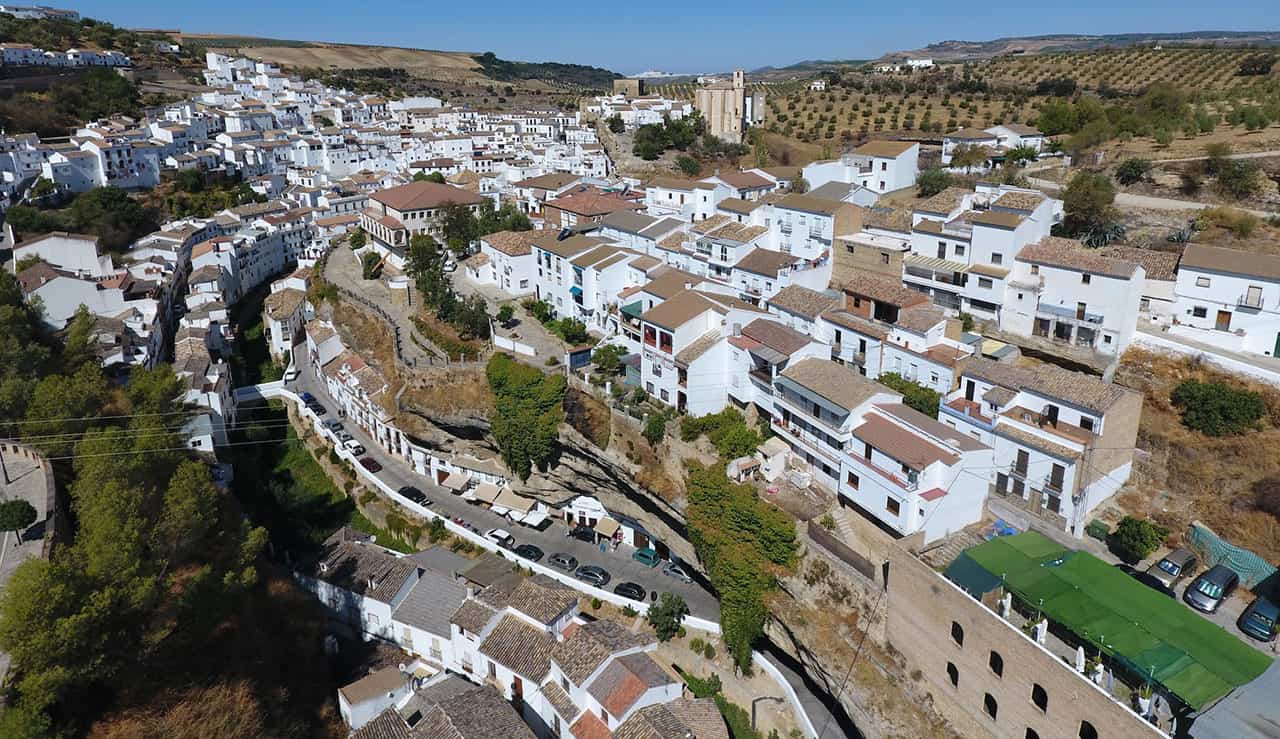
Setenil de las Bodegas is an Andalusian white house village with an extraordinary difference. While most of these villages grace hilltops like a scattering of white dice on a quilt of brown and green, this one sits deep within a rocky gorge.
Many of the houses are built into the sides of the gorge, into caves thousands of years old, and wrap around boulders and other rock outcrops.
The result is that Setenil de las Bodegas is now one of the strangest, but also one of the most intriguingly beautiful white dice villages in this region. The narrow walls of the canyon mean that the village cannot be overdeveloped, but there is plenty of free parking if you arrive early enough.
Where is Setenil de las Bodegas
Situated inland and to the North West of Màlaga, Setenil de las Bodegas was once a major wine-producing village.
It still does have a winemaking industry but today it is a huge tourist draw due to its amazing setting.
- When you arrive in town there is little to give you a clue about its cave-dwelling streets at the bottom of the ravine.
- As you spill down the sloping lanes and walkways the village rises above you revealing rock outcrops and stone ridges.
How Do You Get to Setenil las Bodegas
There are day trips and coach trips that start out from Màlaga if you don’t want to do the drive yourself. It is just over 90 km (56 miles) and the roads being what they are, it shouldn’t take more than an hour and a half by road from the city.
- The coaches can’t get into the village center as the streets are too twisty and too narrow.
- Be prepared to walk a little way to get to the heart of Setenil las Bodegas.
- The local roads are never very busy once you are out of the city.
- I’d take the A35 past Ardales, then follow the A367 to Cuevas del Becero, after which it’s the MA414 all the way to Setenil de las Bodegas.
The first car park you come to fills up fast so if you arrive by noon then it’s a good idea to push on a little further. Just off the main street, the Calle F Garcia Lorca, down a narrow lane, there is another car park that always has space, although I’d recommend taking it slow on these roads!
- The center of town is open only for residents’ vehicles, so please pay attention to the road signs and follow the blue car park signs.
- If you see any signs with the words ‘acceso exclusivo para residentes y titulares de permisos’ or similar, it’s time to turn around!
What to See When You Get to Setenil de las Bodegas
There’s really only one main reason to visit Setenil de las Bodegas and that is for the streets of cave houses.
There are other things to see in the village and missing them from your list would be a terrible waste!

- The Rocky Streets of Setenil de las Bodegas
This is definitely a walking tour, and there are a number of flights of steps between some levels. However pretty much everywhere is accessible with a wheeled vehicle or a stroller, it just takes longer to get from the bottom to the top of the village.
- Calle Cuevas del Sol runs alongside the river Trejo and is packed full of bars and places to stop for a drink in the shade of the overhanging rock.
- It’s in the lower part of the village and is likely the first street you will enter that has the signature rock overhang dominating things.
- Several small bridges cross the Trejo and you can walk on these to admire the views up and down the river valley, the white houses, and the rock formations.
- Calle Cuevas de la Sombra has been built so deep into the caves that the rock outcrop extends right across the street and into the roof of the row of houses opposite.
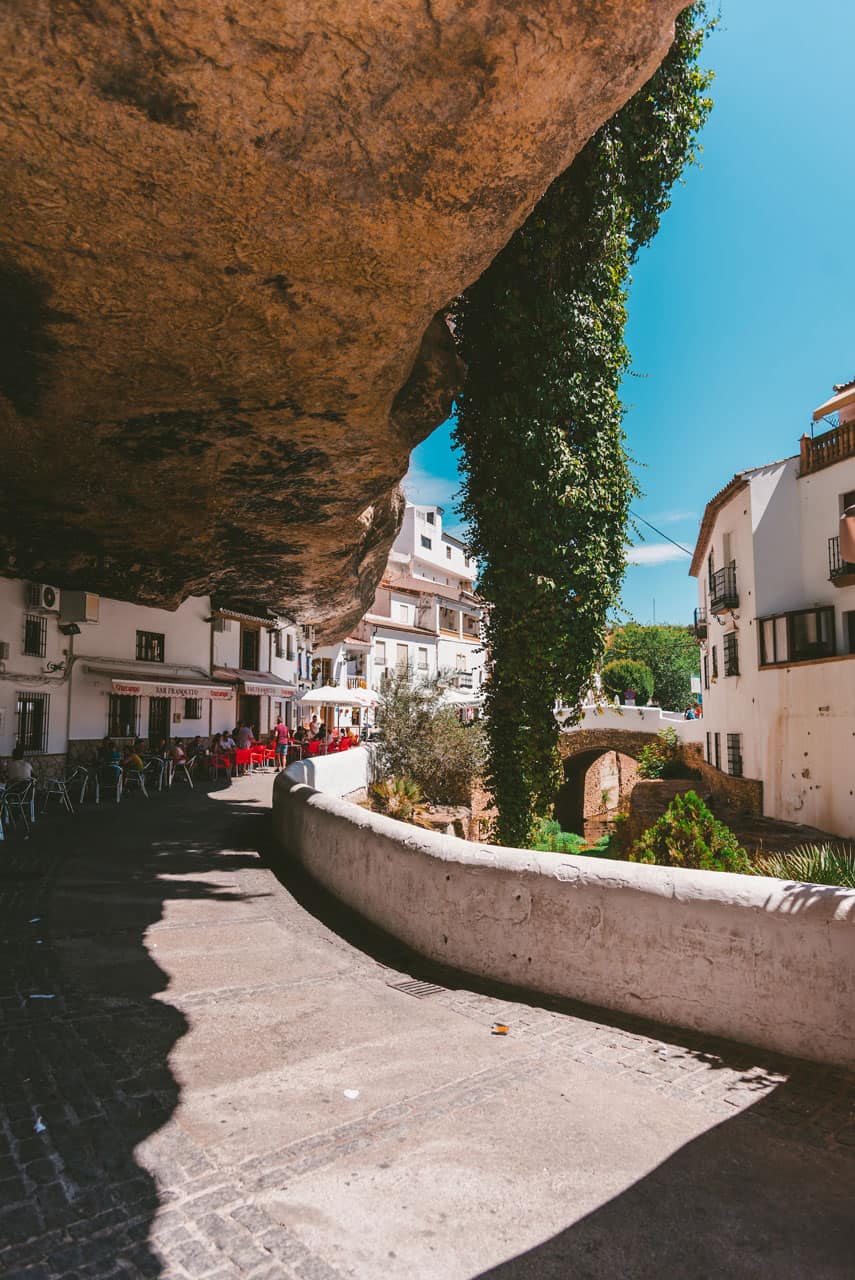
Check out the menus through here to get a feel for the local specialties. I’d recommend the asparagus soup if you are visiting in the Spring or Autumn as it will warm you up if the stones are chilly.
- Calle Herrería has a lovely spot for your Instagram hit, a corner at one end of the street filled with ceramic flowerpots and the words ‘bésame en este rincon,’ or ‘kiss me in this corner’.
- Some of the locals on this street like to open up their houses to tourists for a small tip or fee of around a Euro per person. These aren’t museums, but actual homes built into the rock.
- It’s not official and they aren’t open every day, but you never know your luck!
- Apart from the main street, the Calle de la Cuevas, with its souvenir shops and restaurants there are several other lanes which are set a little apart from the main tourist hub.
Here you can perhaps spot some of the real Andalucia, and get a more authentic feel for life in the village, how the place is when the tourists have all gone home. There are a half dozen or more streets where the locals have used the rock overhangs as shelter in this way.
Breathe it all in, the cooking smells, the aroma of the jasmine, and the brightly colored pink geraniums in their sky-blue pots.

- The Mirador del Carmen and the Churches
From the Calle Cuevas del Sol, there is a narrow flight of stairs that will bring you up to the Mirador del Carmen. From this viewpoint, you can take in the entirety of the village.
Watch out, it’s a pretty steep climb, but it is definitely worth the effort!
- The patron saint of the town resides in the Ermita de Nuestra Senora del Carmen right behind you.
- There are five churches in Setenil de las Bodegas, all of which are built over the foundations of earlier mosques.
- The Iglesia Nuestra Senora de la Encarnacion dominates the hilltop. Inside it is as white as the village houses are on the outside.
- The Ermita de San Benito is a sweet little church right by another steep, narrow staircase that takes visitors up and down between the myriad levels of the town.
- The Ermita is one of those classic little Spanish churches, white with a splash of color, where the outside outshines any interior fancies.
- The Mirador del Lizon
Opposite the Mirador del Carmen is another viewpoint, high on the rock up above Andalucia Square and on the way to the Torre de Homenaje.
- Thanks to its strategic location, it offers stunning views of Setenil de las Bodegas and it’s THE place to see for any photography enthusiasts.
- If you want to capture the best scenery, I recommend venturing out the viewpoint around sunset time, allowing you to capture the golden hour images of the village.
- Alternatively, another excellent option for those staying in the village is the sunrise photo moments from the Mirador.
- The viewpoint is located at Ventosilla Alta Street, 27, and you can access it easily on foot from the center of the village.
- For more great photo opportunities you can also visit the nearby Mirador Balcon de Setenil de las Bodegas

- The Muslim Fortifications of Setenil de la Bodegas
Up above the village overlooking the entire valley is the 11th-century Moorish fort, just one tower remains out of forty defensive structures built up over the centuries.
- The Torre de Homenaje is all that remains of a massive Moorish fort that helped to hold off the Christian Reconquista forces in the 15th century.
- The fort was so successful that it managed to withstand seven attempts at its capture before wider swathes of territory were captured and the fort cut off.
- According to local folklore the seven thwarted attempts to overthrow the castle gave the village its name, ‘Septem Nihil’ is the Latin root of Setenil and means ‘seven times nothing.’
- Beneath the fort is a cistern that was built to supply the castle with water. This can be visited too. Tickets are sold in the tourist office next door.
- The Casa Consistorial
Not your average tourist office, the Casa Consistorial is an amazing survival from the days of Muslim rule. Make sure you look up as you enter and take in the incredible carpentry on the ceiling, which is the absolute highlight of the construction.
- On one of the beams, someone has inscribed the date of September 21, 1484, the day that Setenil finally fell to the Catholics.
- The building used to be a town hall and is currently used as the main tourist office. You can visit this building for free every day except Monday.
- You will find Casa Constistorial at Calle Villa 2, a short walk away from the Castillo de Setenil de las Bodegas.
- Within walking distance from the tourist office, you will also find Mirador de la Villa, an exceptional viewpoint offering some of the vest views from the village.
Top Tips for Visiting Setenil de las Bodegas
- Because it is one of those must-see stops on any tour the village fills up every day from 12:30 through to three in the afternoon. If you want to see the village at its best then start out early.
- The main street is the one that you will see on all the postcards, and where most of the restaurants are situated. As a rule, especially on a Saturday during high season, these restaurants are completely full for the entire two-hour stretch over the lunch period.
- Most shut directly after this and won’t open again until eight in the evening when the coach tours will have left. At this time of day, you will have the pick of the available menus.
- For a complete experience consider staying in one of the rock house bed and breakfast places, but be sure to book up well in advance.
- If you stay the night, or for longer you can take in a night tour of the town, or perhaps hike the infamous Bandit Trail that takes you to a ruined Roman town on the way to Rota.
This is a post by guest contributor, Lucia Poellae.
Author Bio: Lucia is a travel blogger living in Southern Spain, sharing her discoveries of beautiful locations, hidden gems, and stunning historical sights on her travel blog Viva La Vita.